
STOLEN ARTWORKS
by Roy Dowding
Published in the FBHVC magazine “Historics” March 2026
The description ‘artwork’ is most readily associated with sculptures and paintings, although it is equally applicable to literature and music. I happen to share the view held by many that some cars can also be considered works of art - perhaps the most obvious example being the Jaguar E-Type.
‘Stolen’ generally means theft, but it can also apply to claiming someone else’s creation as your own or, to give it its proper title, plagiarism. It sometimes happens inadvertently – Princess Michael of Kent has always denied that several passages in two of her books on Royalty were ‘lifted’ from previously published work by others. And the ex-Beatle, George Harrison, found guilty of copying the riff of The Chiffons’ “He’s So Fine” for his “My Sweet Lord”, insisted that it was done subconsciously.
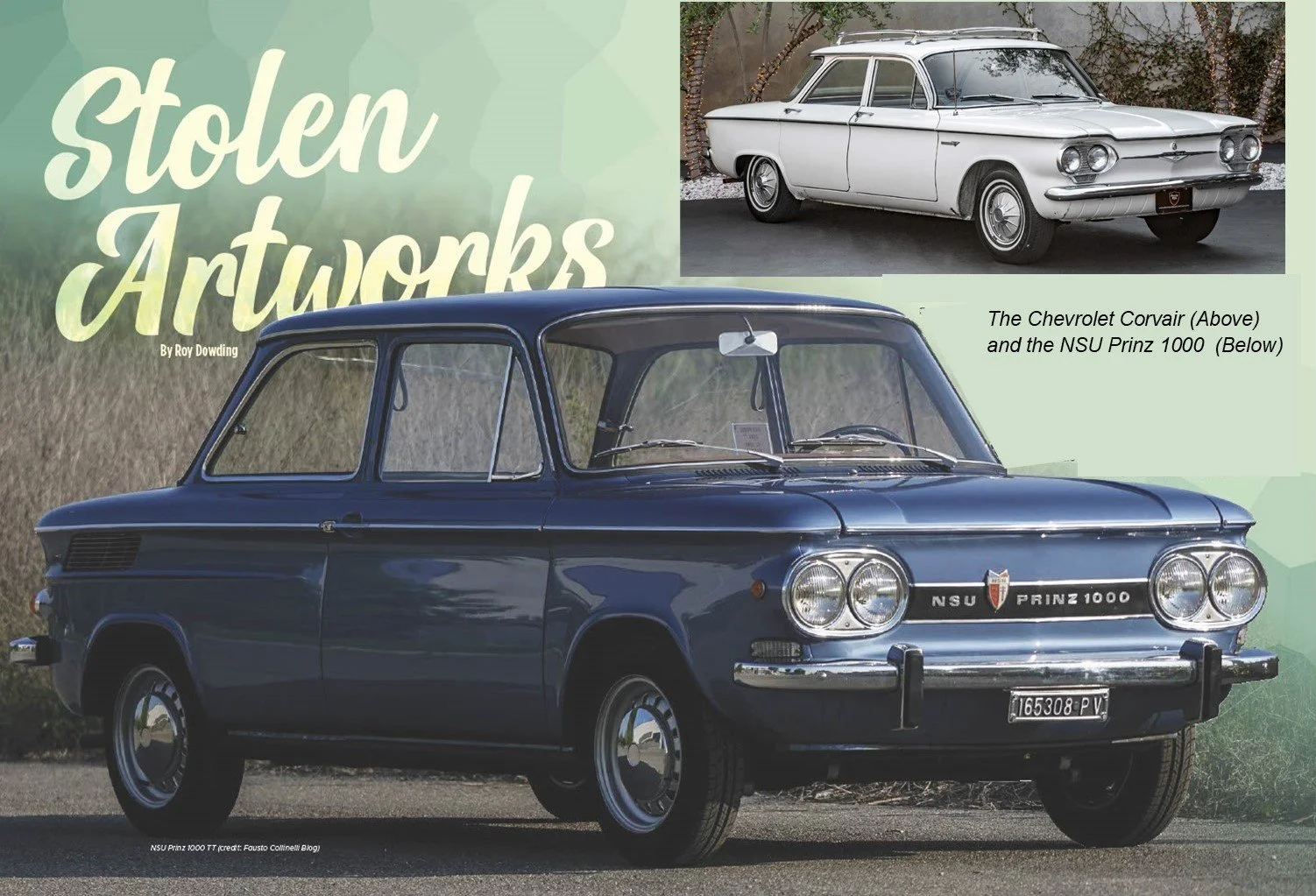
Every now and then car designs are unveiled bearing features that are all too similar to something that has already been seen. Very occasionally, this has been deliberate, as in the case of the 1961 NSU Prinz 4, and particularly the later, larger 1000, which is frequently referred to as the Micro Corvair – a reference to Chevrolet’s 1960 rear-engined compact car. Clearly the styles were exceedingly close, but no lawsuits were filed and, more importantly, NSU never claimed the design was uniquely ‘theirs’.
Sometimes, even though the similarities are indisputable, ownership of a design is blatantly claimed without credit given to the originator. A case in point was highlighted last year by an article in Octane magazine under the heading ‘Man & Machine’, written by Juha Rista, a self-confessed long-time aficionado of the VW Karmann Ghia. He attributed the styling of this intriguing car to Felice Boano, Giovanni Savonuzzi and Luigi Segre, as most sources do.
But there can be no doubt that the basic inspiration came from Virgil Exner, arising from the period during the early 1950s when this visionary American designer collaborated with Ghia and Chrysler on a series of 'Styling Specials', one of which was the D'Elegance of 1953. The production version of the VW was unquestionably derived from the Exner car, albeit slightly scaled down and with a revised front end, reflecting the rear engine layout.
On seeing one in 1955, Exner is noted as “having been pleased that one of his designs had made it into large-scale production”. But Boano always denied that he had stolen the essence of the design from the D'Elegance. It is rather intriguing, however, that Ghia gifted Exner one of the very first production models… “in appreciation”!
This was by no means the first example of his work at Ghia being ‘borrowed’. A drophead version of the Ghia Dodge Fire Arrow, initially sketched in 1952, appeared at the Turin Motor Show in 1953 alongside a distinctly similar, though smaller, car called the Ghia Abarth 1100 Sport. Its design has been attributed by some to Giovanni Michelotti, although he has never endorsed this assertion.
No reference was ever made to the obvious inspiration of Exner’s Fire Arrow - the bold horizontal body line, oval frontal aspect, distinctively shaped wheel arches and side windows, down to side lamps on the 1100 ‘replacing’ the pronounced bulges atop the Fire Arrow’s front wings. The Abarth 1100 won the 2021 Audran Newport Concours – though still no recognition was paid to its origins in the description that accompanied its entry.
That Exner did not seem upset is perhaps explicable by virtue of his having previously worked for several years with Loewy Design Associates and then at Studebaker under Loewy. In both cases, his contributions were totally undermined by Raymond Loewy’s insistence in signing off all designs with his name.
One of the last projects that Exner worked on before leaving Studebaker in 1950 was a coupé which he had initially drawn in 1948 but was not progressed at that time. It heavily influenced that company's overall styling from 1953 to 1957, while the coupé itself became the ‘Hawk’ series, little changed from how Exner had left it. But guess who took the credit? Loewy is seen with the ‘new’ Studebaker Commander in 1953.
Sadly, one of Virgil Exner’s most emphatic designs was stolen from its public unveiling through fateful mistakes by two ship captains, neither of whom made their intentions clear enough while navigating in fog. I am referring, of course, to the calamitous collision between the Italian liner ‘Andrea Doria’ and the Swedish vessel ‘Stockholm’, in 1956 off Nantucket.
On board the Italian ship, bound for the New York Motor Show, was the Chrysler Norseman, having been 3 years in development by Ghia in Turin working from Exner’s original 1953 drawings. What remains of the car is still in the hold to this day – sitting on the seabed.
A step beyond the famous ‘Forward Look’ that he later developed for Chrysler from the mid-1950s, the distinctive roofline and elongated rear flanks of the Norseman concept would ultimately morph into the 1965 Dodge Charger show car. And it was even a recognisable influence, from the B-pillar aft, on the 1966 AMC Marlin.
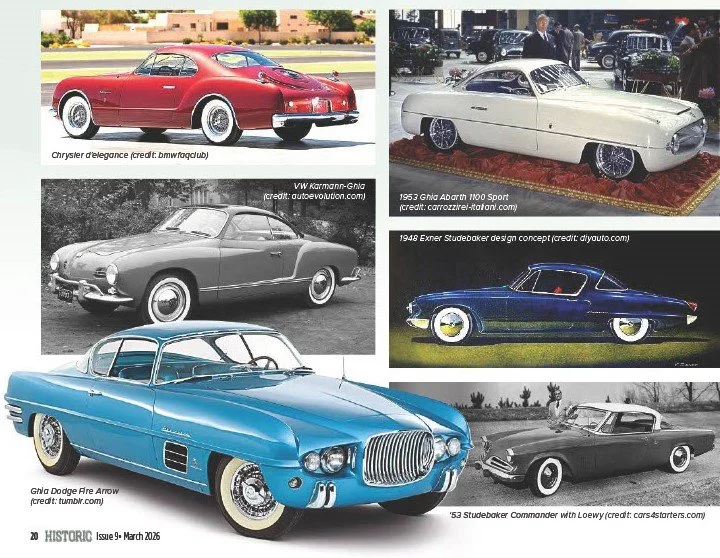
Clockwise from above: Ghia Dodge Fire Arrow, VW Karmann-Ghia, Chrysler D’elegance, 1953 Ghia Abarth 1100, 1948 Exner Studebaker design concept, 1963 Studebaker Commander
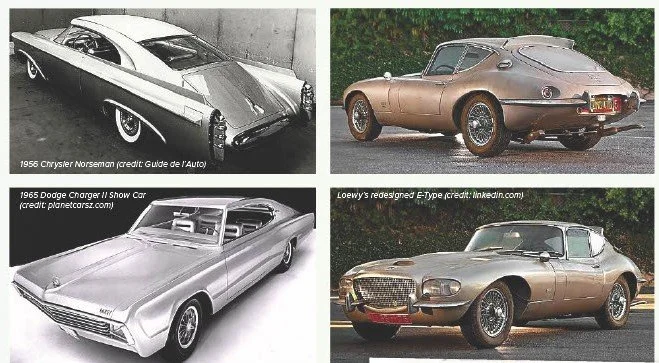
Clockwise from above: 1965 Dodge Charger, 1956 Chrysler Norseman and Loewy’s redesigned E-Type
While so many of Virgil Exner’s design studies are not always readily associated with him, his ‘Forward Look’ models for Chrysler, De Soto, Dodge, Plymouth and Imperial, most certainly were. Subtly updated each year from 1955 to 1960, they will forever be his indisputable ‘pièces de résistance’.
So advanced were they - appearing to be ‘straining at the leash’ even at a standstill - that when GM designer Chuck Jordan secretly spied examples of Exner's 1955 Chrysler line-up, it prompted Bill Mitchell, head of General Motors styling, to order his studios to “begin redesigning each GM car line, Chevrolet through Cadillac”. This undoubtedly is one of the reasons that led to the oft-quoted statement that “Exner's work effectively changed the course of [US] automotive design”.
Which is more than can be said for his nemesis, Raymond Loewy, who once criticised American cars as “jukeboxes on wheels”. While one must acknowledge the huge raft of his iconic designs for corporate logos, the Coke bottle, streamlined railroad locomotives and the Greyhound Scenicruiser bus, very few cars are on that list. He is accredited by Wikipedia with the Studebaker Avanti and Champion, though the former was almost certainly the work of his team of Tom Kellogg, Bob Andrews and John Ebstein, while the Champion was actually another ‘purloined’ Exner design.
There is perhaps just one car, the styling for which he was personally responsible. Having mentioned earlier the Jaguar E-type, stated by Enzo Ferrari to be “the most beautiful car in the world”, Loewy took it upon himself to ‘improve’ it. Custom-built around a 1966 4.2 litre Series 1 coupé by Pinchon-Parat of Sens, France, the end result was, shall we say, different.